
When watch gaskets need replacing
8 min read
Los artículos se publican únicamente en inglés.
A watch’s gaskets need replacing at every full service, whenever a pressure test shows they no longer seal, and at once if moisture appears under the crystal. A water-resistant watch should also be tested after any opening of the case, and regularly between services if it is worn in water, because rubber ages whether the watch gets wet or not. Water resistance is not a permanent property of a case: it depends on its seals, and it lasts only as long as they do.
Where a watch is sealed
A case has an opening wherever something passes through it or closes it, and each opening has a seal of its own.
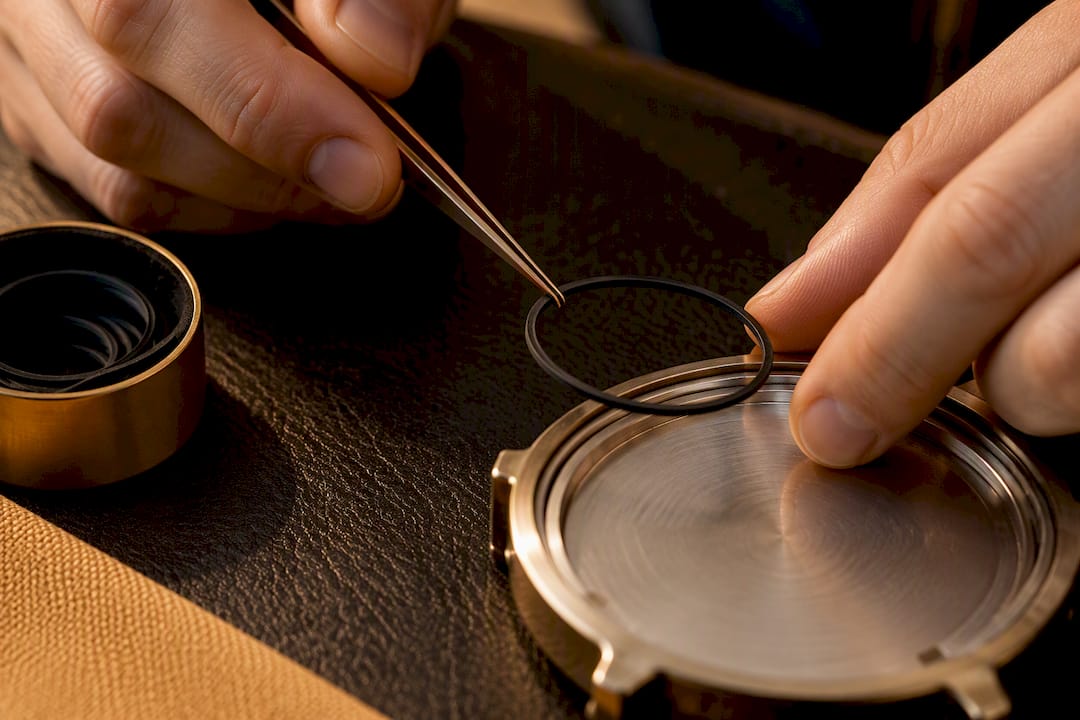
- The case back. A rubber O-ring or a flat gasket sits in a groove or against a shoulder, and is compressed when the back is screwed down, pressed on or fastened with screws.
- The crystal. A pressed-in glass or sapphire crystal usually sits in a ring of firmer plastic, while many acrylic crystals seal by their own tension against the case. Replacing a watch crystal covers how each is fitted.
- The crown and its tube. Small gaskets close the gap between the crown and the tube it sits on, and a screw-down crown compresses its gasket as it is tightened (see crowns, stems and tubes).
- The pushers. Each chronograph pusher has gaskets of its own.
A leak at any one of these lets moisture in. A watch is only as water-resistant as its weakest seal, which is why a new case back gasket on its own does not always cure a leak.
Why gaskets wear out
Gaskets are made of rubber and plastics, and both age. Over the years they harden, lose their elasticity and take a set: an O-ring squeezed in its groove for a long time stays flat when it is released and no longer presses back against its seat. Perspiration and moisture hasten the process, and so do heat, steam, soap and solvents, which is why manufacturers advise against wearing a watch in a hot bath or a sauna.
Other things open gaps too. A hard knock can distort a case part enough to break a seal. Opening the case for any reason, a battery change included, disturbs the case back gasket, and an old one that has taken a set rarely seals as well once it has been moved. None of this shows from outside. A watch can look immaculate and leak, and the gaskets of a watch that spends years in a drawer still age.
What the rating on the case means
A marking of 30 m, 50 m or 100 m (3, 5 or 10 bar) records the pressure a watch is built to withstand in a static laboratory test. It is not a depth to which the watch can safely be taken. ISO 22810 sets out the requirements and tests for water-resistant watches, and divers’ watches are a separate class under ISO 6425, with stricter requirements of their own.
Manufacturers’ guidance reflects the gap between the number and real use. In Seiko’s table of its ratings, a watch marked 3 bar is suited only to splashes and rain, one marked 5 bar to swimming and showers as well, and even one marked 20 bar is not meant for scuba diving unless it is a divers’ watch. A rating also describes the watch as it left the factory, with new gaskets. Years later, only a test can say what it still resists.
When to have them replaced
- At every full service. The movement comes out and the case is stripped, and new gaskets are a normal part of what a full service involves.
- After the case has been opened. A battery change, or any other work that opens the back, should end with the case back gasket checked or renewed and, on a watch rated for water, a pressure test.
- On the maker’s schedule, or when a test fails. Intervals vary by brand. Citizen’s guidance on water resistance recommends regular servicing with the gaskets replaced at least every two to three years, while Seiko asks owners to have water resistance checked regularly. For a watch worn in water, a test between services is the only way to know the seals still hold, and a failed test means finding the seal that leaks and renewing it.
- At once, if moisture appears. Mist under the crystal that does not clear within a few minutes, droplets, or rust spots on the dial or hands mean water is inside. Stop wearing the watch and have it opened and dried promptly: moisture left in a case corrodes steel parts and marks dials, and the damage grows the longer it stays.
How the work is done
- The case is opened and the old gaskets come out: the case back’s first, the crown’s with the crown and stem, and the crystal’s, when it is renewed, once the movement is out of the case.
- Grooves and seats are cleaned of old grease and debris, which would otherwise hold a new gasket off its seat.
- New gaskets are chosen. Where the manufacturer’s part is available, that is the one to fit; otherwise a gasket of the right material is matched to the groove by measurement, since gaskets are specified by diameter and thickness to fractions of a millimetre.
- Rubber gaskets get a thin film of gasket grease, which helps them seat without twisting, and the case is closed without pinching them.
- The watch is pressure-tested.
A gasket slightly too large is pinched or cut as the case closes; one slightly too small never presses against its seat. Neither looks wrong once the back is on, which is why the last step is not optional.
How the seal is tested
There are three ways to test a seal, and a workshop uses them together where they suit the watch. A dry tester seals the watch in a chamber, raises the air pressure (many machines also draw a vacuum) and measures how the case flexes. If the case leaks, the pressure inside and outside evens out, and the reading shows it. No water touches the watch, which makes this the safe first test for any piece.
A condensation test warms the watch and chills its crystal: mist on the inside means moisture is already in the case. A water test, where the watch is suited to it, immerses the case under pressure and shows a leak as a stream of bubbles, which also shows where the leak is. Whichever is used, the test is made to the watch’s specification, and a pass describes the watch on the day it was tested. It is not a promise for the years after, which is why the seals need checking again in time.
Vintage watches and water
Older watches call for more caution. Original gaskets for many vintage cases are no longer made, so new ones are chosen by measurement, and years of wear in a case back thread, a crown tube or a crystal seat can leave a case that no gasket will return to its original rating. A correctly restored vintage watch may not be water-resistant by modern standards, even if its dial or case back says it is. The sensible course is to keep it away from water. The terms of Viattori’s warranty reflect this: water and moisture damage is excluded on any watch, and vintage watches are not warranted against moisture, whatever their markings say.
Case back, crown, pusher and crystal gaskets are all part of Viattori’s repair service. They are replaced in-house, and a watch rated for water is pressure-tested to its specification before it goes back. The assessment and written estimate are free, and nothing is done until the estimate is approved.
Questions
How often should watch gaskets be replaced?
At every full service, and whenever a pressure test shows they no longer seal. Between services, a watch worn in water should have its water resistance tested regularly and after any opening of the case. Some manufacturers set an interval of their own: Citizen, for example, recommends replacing the gaskets at least every two to three years.
Does a battery change affect water resistance?
It can. Opening the case disturbs the case back gasket, and an old gasket may not reseal properly. On a water-resistant watch, a battery change should end with the gasket checked or replaced and the watch pressure-tested before it goes near water again.
Is a watch marked 50 m safe for diving?
No. A 50 m (5 bar) marking is the pressure the watch is built to withstand in a static laboratory test, not a safe depth, and manufacturers generally rate such watches for swimming at most. Diving calls for a divers’ watch made to ISO 6425.
What does condensation under the crystal mean?
Mist that clears within a few minutes is no cause for concern; mist that stays means moisture is inside the case. Stop wearing the watch, keep it out of water and have it opened and dried promptly, because moisture left inside corrodes steel parts and can mark the dial. The seal that let it in then has to be found, replaced and tested.
Can I replace a watch gasket myself?
Fitting one is the easy part. Without a pressure tester there is no way to know that the case seals, and a gasket slightly too large or too small looks no different once the back is closed, so a watch that will see water needs a pressure test after any gasket work.