
Replacing a watch crown and stem
7 min read
Los artículos se publican únicamente en inglés.
A broken, damaged or lost crown can almost always be replaced. The crown is only the visible end of a small assembly, though: a winding stem that runs into the movement, a tube in the case that the crown sits on, and the gaskets that seal the two. A proper replacement matches the crown to all of them, cuts the stem so that the crown sits where it should, and ends with a pressure test, because the crown is one of the case’s seals.
How the crown works
On most watches the crown screws onto the outer end of the stem. The stem passes through the case tube into the movement, where a small spring-loaded part, the setting lever, holds it at each of its positions. Pushed in, the crown winds a mechanical watch. Pulled out, it shifts parts of the keyless works so that the same stem sets the hands instead, and many calendar watches have a middle position for the date. To take the stem out, a watchmaker presses a small release on the movement or loosens the setting-lever screw, and the crown and stem slide out together.
The tube is a short sleeve fixed into the case: screwed or pressed in, and on some watches glued or soldered. It gives the crown something to seal against. A gasket, inside the crown or inside the tube, closes the gap between the two, and where the gasket lives inside the crown, a worn one is often cured with a new crown.
Push-pull and screw-down crowns
A push-pull crown seals by its gasket alone. A screw-down crown threads onto the outside of the tube and compresses its gasket as it tightens, which is why divers’ watches usually have one. It has to be unscrewed before it can wind or set the watch, and screwed fully home again before the watch goes near water.
A screw-down crown needs a little care. Turned home at a slight angle, it crosses its thread, and forcing it then damages the threads of the crown, the tube or both. Push it in gently, turn it until the thread catches without any force, and stop when it is snug. Seiko’s care advice adds two habits worth keeping with any crown: never turn or pull it out while the watch is wet, and turn it from time to time so that its gasket stays supple.
What the symptoms usually mean
Several crown faults have causes further inside the watch. The table gives the usual causes, not the only ones; faults that look alike from outside can only be told apart once the watch is open.
| What happens | Usual cause | Usual remedy |
|---|---|---|
| The crown comes off in the hand, leaving the stem in the watch | The crown has unscrewed from the stem, or its thread or the end of the stem has broken | The crown refitted or replaced, and a new stem if its thread is damaged |
| Crown and stem pull out together | A loose or broken setting lever, or a stem snapped inside the movement | The setting lever put right, and the stem refitted or replaced |
| A screw-down crown will not catch or tighten | Crossed or worn threads on the crown or the tube | A new crown, a new tube, or both |
| On a manual-wind watch, the crown turns endlessly and never winds tight | Often a broken mainspring rather than a crown fault; sometimes a broken stem or worn winding parts | A new mainspring, stem or winding part: work on the movement, not just the crown |
| Mist under the crystal after the watch has been in water | A crown left unscrewed or pulled out, or worn gaskets in the crown or tube | The watch opened and dried, the seal renewed, then tested |
Matching the crown, stem and tube
A replacement crown has to fit three things at once: the stem’s thread; the tube, meaning its diameter, its gasket arrangement and, for a screw-down crown, its thread; and the case, whose shoulders or crown guards leave room for a crown of a certain diameter and height. It should also look right. Many brands sign their crowns with a logo, and on a vintage watch the correct signed crown is part of its originality and its value to collectors, one of the details covered in checking a vintage watch before buying. Genuine crowns for some brands are available only through the brand. Where that applies, an equivalent part can be proposed, and it should always be disclosed before it is fitted.
Stems are made for a particular calibre, and a replacement usually arrives longer than any one case needs. It is cut so that the crown, pushed home, sits against the tube as designed. Left too long, the crown stands off the case and its gasket cannot seal; cut too short, the stem cannot be lengthened again and has to be replaced. Watches whose movement comes out through the front often use a two-piece stem that separates when the movement is removed, and its two halves must match each other as well as the movement.
A worn, bent or corroded tube, or one whose thread has been crossed, cannot be put right with a new crown alone. Replacing it means finding a tube that fits both the case and the crown, removing the old one without marking the case (a glued or soldered tube needs heat to release it), and fitting the new one square, so that the crown seals evenly all the way round.
Testing, and how long it takes
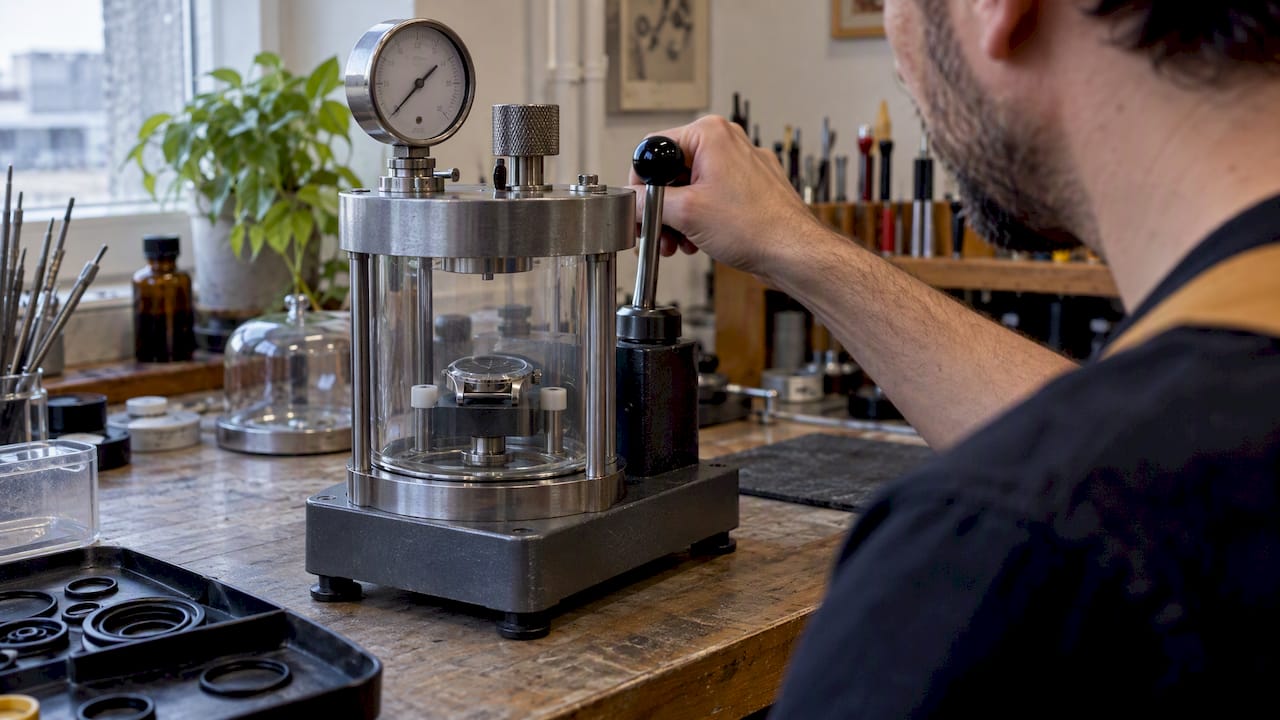
Any work on the crown, stem or tube ends with a pressure test. A crown whose gasket is not quite seated looks exactly like one that seals, and only the test tells them apart. While the case is open, the other seals deserve a look as well: a crown that has let moisture in may not be the only part that has aged, and gaskets and water resistance explains what is checked.
With the right parts at hand, a crown and stem replacement is a small repair, the kind usually ready in one to two business days. A genuine crown that has to come from the brand, or a tube that has to be sourced, takes as long as the part does, and the written estimate gives a good-faith completion date. If the watch is still under its manufacturer’s warranty, check that first: a crown fault may be covered, and opening the case elsewhere may affect the warranty.
Crown, stem and tube work is part of Viattori’s repair service and is done in-house, after a free assessment and a written estimate that the owner approves before any work begins.
Questions
Can a broken watch crown be replaced?
Almost always. The new crown has to match the stem’s thread, the case tube and the case itself, the stem is cut so that the crown sits correctly, and the watch is pressure-tested afterwards, because the crown is one of its seals.
Why won’t my screw-down crown screw in?
Usually because the thread has not caught squarely, or because the threads on the crown or the tube are crossed or worn. Push the crown in gently and turn it without force; if it still will not catch, stop and have it checked, since forcing it damages the threads.
Does a replacement crown have to come from the brand?
Not always, but it matters for originality and value, particularly on a vintage watch with a signed crown. Some brands supply genuine crowns only through their own network; where that applies, an equivalent crown can be fitted, and it should be disclosed before it is.
Why does my crown turn without winding the watch?
On a manual-wind watch, a crown that turns endlessly without the mainspring ever winding tight often points to a broken mainspring, which is movement work rather than a crown repair. A broken stem or worn winding parts can cause it too, and only opening the watch tells which.
Does replacing a crown affect water resistance?
Done properly, it restores the seal rather than weakening it, but only a pressure test can confirm that, which is why any crown, stem or tube work on a water-resistant watch should end with one.