
Replacing or polishing a watch crystal
7 min read
Los artículos se publican únicamente en inglés.
Whether a damaged crystal can be saved depends on what it is made of. Scratches in acrylic can usually be polished out. A scratched mineral or sapphire crystal, and a chipped or cracked crystal of any material, is replaced. Replacement is routine on most watches, as long as the new crystal matches the old in material, size and profile, goes in the way the case was designed to hold it, and is followed by a pressure test on any watch meant to resist water.
Acrylic, mineral glass and sapphire
Acrylic
Acrylic is a clear plastic, light and slightly flexible; Omega’s Hesalite crystal, best known from the Speedmaster Moonwatch, is one. It scratches easily, but most scratches are shallow enough to polish out, and under a hard knock it tends to crack rather than shatter. Many vintage watches left the factory with an acrylic crystal, often domed, and its profile and the slight distortion at its edge are part of how they should look.
Mineral glass
Mineral glass is ordinary glass, usually hardened, and the standard crystal on a great many everyday watches; Seiko’s Hardlex is one such hardened glass. It resists everyday scratches far better than acrylic, but a sharp knock can chip or break it, and its scratches cannot practically be polished away.
Sapphire
A sapphire crystal is synthetic sapphire, 9 on the Mohs hardness scale, and very little in daily life will scratch one. Hardness is not toughness, though. A sharp knock, especially at the edge, can chip or crack a sapphire crystal, and it cannot be polished at home. Many sapphire crystals also carry an anti-reflective coating, and on the outer face that coating can scuff or wear long before the sapphire does. Marks in the coating look like scratches in the crystal, and the usual remedy is a new crystal either way.
Polish or replace
An acrylic crystal with light or moderate scratches is a good candidate for polishing, which takes a thin layer off the surface and keeps the crystal itself. On a vintage watch, where the crystal may be original, that matters. Polishing removes material, though, so a deep gouge is better solved with a new crystal than by polishing ever deeper, and a crack in acrylic cannot be polished out at all.
Scratched mineral glass and sapphire are replaced, or lived with. Chips and cracks in any material mean replacement, and promptly. A cracked crystal no longer seals, and a fragment loose inside the case can scratch the dial, catch the hands or find its way into the movement. Citizen’s guidance on water resistance lists damage to the glass, alongside aging gaskets, as something that impairs water resistance, and a chip at the edge can let water in even when the face looks clear. Until the watch can be seen, stop wearing it, keep it dry and avoid pressing on the crystal.
Finding the right crystal
Crystals are made in steps of a tenth of a millimetre, and the right one is defined by more than its diameter: its thickness, its profile (flat, domed or high-domed), the shape of its edge, and details such as a date magnifier, which is part of the crystal and has to sit exactly over the window. How the case holds the crystal also decides the size. An acrylic crystal held by tension is chosen slightly larger than its opening; a glass crystal set in a gasket is chosen together with the gasket for its seat.
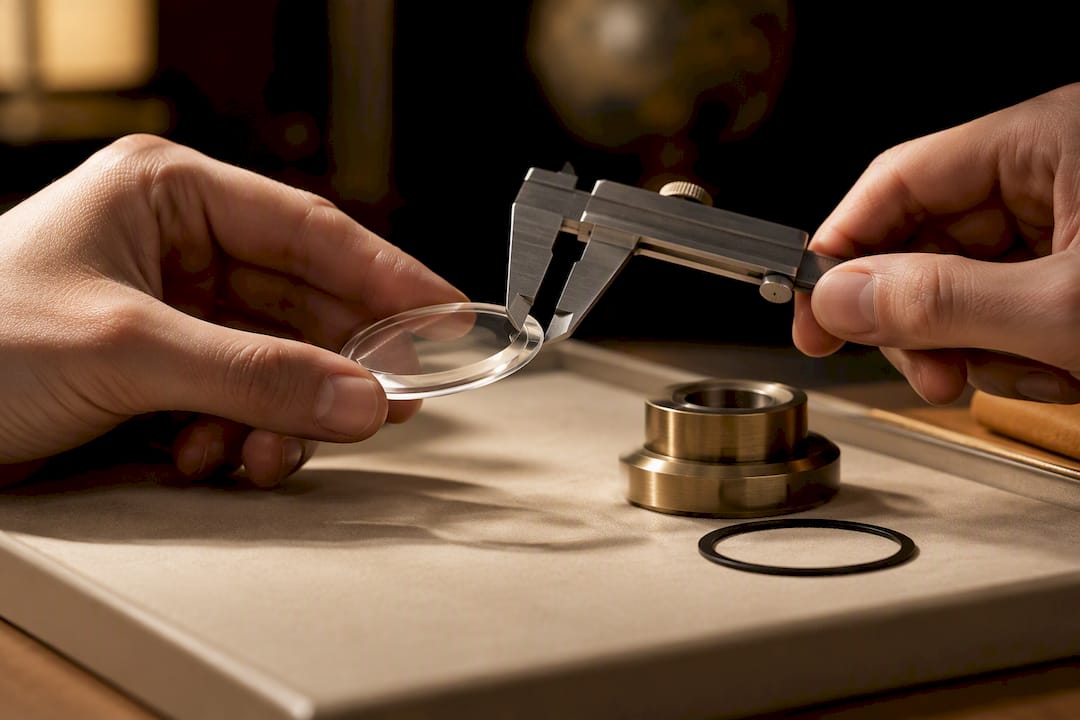
For many modern watches, the right crystal is the manufacturer’s part for that reference. Some brands restrict their parts to their own service network; where that applies, an equivalent crystal of the same dimensions can be proposed, and it should be disclosed before it is fitted. Shaped crystals (rectangular, tonneau or cushion) and unusual vintage profiles can take longer to find.
A change of material is not always an option. Sapphire in place of mineral glass often is, where a sapphire of the same size and profile exists, though it alters the reflections and the look of the watch. A case made for a tension-fitted acrylic crystal, on the other hand, may not hold a glass one at all. On a vintage watch the usual advice is to keep the material it was made with: an acrylic crystal of the correct profile is part of its originality, and keeping it is the approach of a sympathetic restoration.
How a new crystal goes in
A crystal is held in one of a few ways: pressed into the case, usually with a gasket around its edge; held by tension, as many acrylic crystals are, often with a metal tension ring inside the edge pushing it outward against the case; or, on some watches, glued. The work follows from that.
For a pressed-in crystal, the movement normally comes out of the case first, to protect the dial and hands and so that the case can be cleared of any fragments. The old crystal is pressed out, the seat is cleaned, a new gasket goes in, and the new crystal is pressed home with a die that suits its profile, so that the pressure is spread evenly and the crystal seats level. An acrylic crystal is usually compressed in a crystal lift, eased into the case and released to grip. Dust is cleared from the dial and the inside of the crystal before the watch is closed, and a watch rated for water is then pressure-tested: a crystal whose gasket has not seated properly can look perfect and still leak. Gaskets and water resistance describes the tests.
What decides the time and cost
Most of it comes down to the crystal: its material, whether it is a stock size or a genuine part that has to be ordered, and its shape and profile. Around the part, a pressed-in crystal means taking the movement out, a new gasket and a pressure test, all of which belong in the estimate. What decides the cost of a watch service sets out the wider picture.
Viattori replaces acrylic, mineral and sapphire crystals in-house and polishes acrylic ones. With the crystal at hand it is a small repair, usually ready in one to two business days; a crystal that has to be sourced takes longer, and the written estimate, which is free, gives a good-faith completion date. How Viattori takes in a watch covers the rest.
Questions
Can a scratched watch crystal be polished?
An acrylic crystal usually can: light and moderate scratches polish out, though a deep gouge or a crack calls for a new crystal. Scratched mineral glass and sapphire are replaced rather than polished, and marks on a sapphire are sometimes wear in its anti-reflective coating rather than in the crystal itself.
What is the difference between mineral and sapphire crystals?
Mineral glass is hardened ordinary glass: it resists everyday scratches far better than acrylic but can chip or break under a sharp knock. Sapphire is synthetic, 9 on the Mohs scale and much harder to scratch, but it is brittle too, and a sharp knock at the edge can chip or crack it.
Can I fit a sapphire crystal in place of mineral glass?
Often, if a sapphire of the same size and profile exists for the case, though it changes the watch’s look. A case made for a tension-fitted acrylic crystal may not hold a glass one, and on a vintage watch the usual advice is to keep the material it was made with.
Does replacing a crystal affect water resistance?
It should restore it, provided the fit is right. A pressed-in crystal needs a new gasket of the correct size, and a watch rated for water should be pressure-tested after any crystal work, since a crystal whose gasket has not seated can look perfect and still leak.
What should I do if my watch crystal cracks?
Stop wearing the watch, keep it dry and avoid pressing on the crystal. A cracked crystal no longer seals, and a loose fragment can scratch the dial, catch the hands or reach the movement, so it should be replaced promptly.