
Choosing between quartz and mechanical
7 min read
Los artículos se publican únicamente en inglés.
Choose quartz if you want a watch that keeps closer time than a mechanical watch can and asks little of you beyond a new battery every few years. Choose mechanical if you value the movement itself: a watch that runs on a spring and can be serviced, adjusted and repaired for generations. In return it asks you to accept a few seconds a day of variation and a full service every five to seven years. Neither is the better watch in general. One is usually the better watch for a particular owner, and owning one of each is a perfectly sound answer.
How each one keeps time
In a quartz watch, a battery drives a tiny quartz oscillator that vibrates 32,768 times a second. An integrated circuit counts those vibrations and, once a second, sends a pulse to a stepping motor that turns the gears and hands. That is why the seconds hand on most quartz watches moves in single, one-second steps.
A mechanical watch stores its energy in a coiled mainspring. A train of wheels carries that energy to the escapement, which releases it in small, regular portions to a balance wheel swinging to and fro on its hairspring several times a second. The seconds hand advances with each swing, in steps so small and quick that it appears to sweep. A manual-wind watch is wound by its crown. An automatic is a mechanical watch too, wound by a weighted rotor that turns as the wrist moves.
A few movements sit between the two. Some quartz watches recharge their cell from light or from the wearer’s movement. Some chronographs pair quartz timekeeping with a mechanical chronograph module. Seiko’s Spring Drive is powered by a mainspring alone but regulated by a quartz oscillator in place of an escapement.
Side by side
| Quartz | Mechanical | |
|---|---|---|
| Power | A battery, or a cell recharged by light or motion | A mainspring, wound by hand or by a rotor |
| Typical accuracy | About ±15 seconds a month; about ±10 seconds a year for high-accuracy movements that correct for temperature | Several seconds a day, sometimes more; −4 to +6 seconds a day for a certified chronometer’s movement in testing |
| What disturbs it | Temperature; a strong magnet, usually only while it is close | Position, state of wind, temperature, knocks and magnetism |
| Routine care | A battery every few years, with the gaskets checked | A full service every five to seven years |
| Adjustment | Most cannot be regulated | The rate can be regulated by a watchmaker |
| When it fails | Circuit or coil replaced; inexpensive movements often replaced whole | Parts repaired or replaced, or made where none exist |
| Off the wrist | Runs until the battery is spent | Stops when its power reserve runs out, usually within days |
Accuracy in practice
A typical quartz watch is rated to about ±15 seconds a month, so in daily use it needs setting only a few times a year, often when the clocks change. A quartz oscillator’s frequency shifts with temperature, and high-accuracy movements measure their own temperature and correct for it. Grand Seiko rates its thermocompensated 9F quartz calibre to ±10 seconds a year, and points out that most quartz watches, unlike mechanical ones, cannot be regulated at all.
A mechanical watch is a different instrument. Its rate changes a little with position, state of wind, temperature and the way it is worn. It is therefore judged by its average over several days, not by any single day. Ordinary mechanical watches commonly gain or lose several seconds a day, sometimes more, depending on the calibre and its condition. A certified chronometer’s movement must average between −4 and +6 seconds a day in testing. A mechanical watch can, however, be regulated to suit the way its owner wears it. When one suddenly starts gaining heavily, magnetism is the usual cause, as why a mechanical watch runs fast explains.
Care over the years
A quartz watch’s routine is a new battery every few years. Each change opens the case, so it is also the moment to check or replace the case-back gasket and, for a watch meant to resist water, to pressure-test it. Gaskets and water resistance have an article of their own. A dead battery should not be left in a stopped watch, since a leaking cell can corrode the movement. Quartz movements have lubricated gears too. Good ones can be serviced, while many inexpensive ones are designed to be replaced whole when they fail.
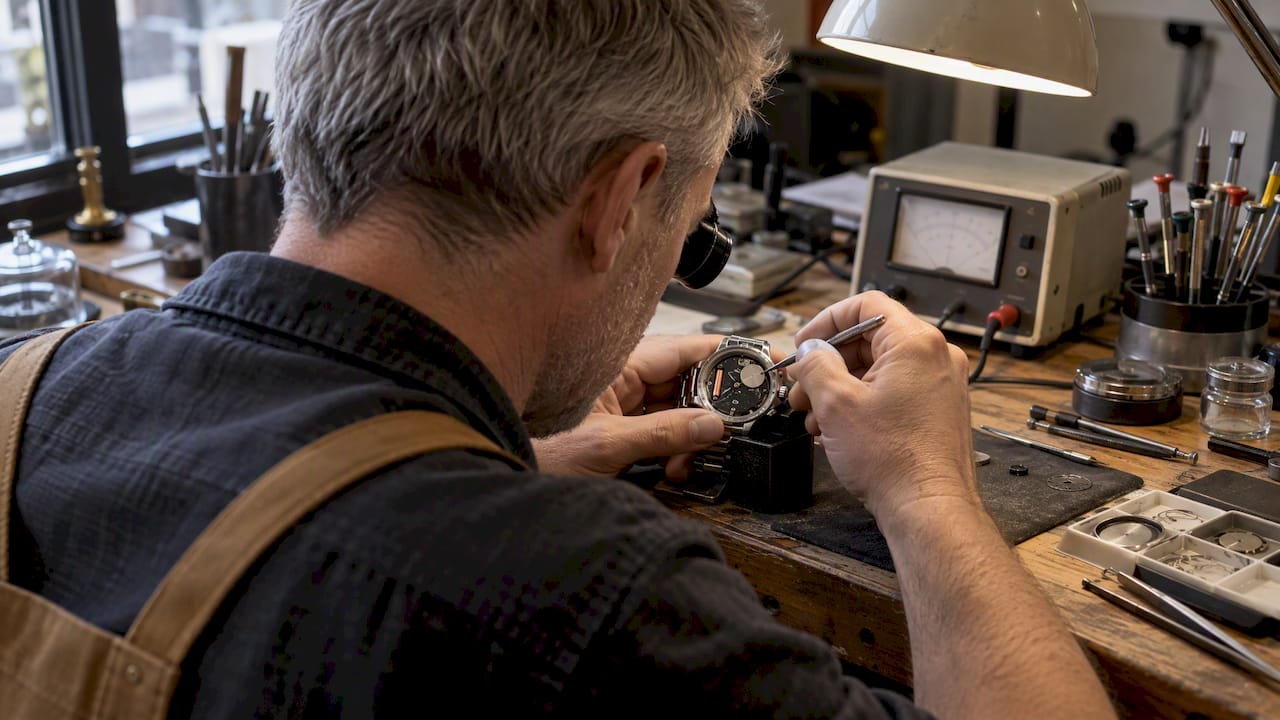
A mechanical watch needs a full service every five to seven years. The movement is taken apart, cleaned, inspected, lubricated, reassembled and timed, as when a watch needs an overhaul sets out step by step. Some manufacturers now quote longer intervals for their own modern movements. A manual-wind watch also wants winding, ideally at the same time each day, and an automatic that is not worn will stop and need setting when it is picked up again. Mechanical watches are more sensitive to knocks and to magnetism, too. As Seiko’s guidance on magnetism explains, a mechanical watch stays magnetized after the magnet is gone. An analogue quartz watch that a magnet has stopped or disturbed usually runs normally again once moved away, though it may need resetting.
The long view
A mechanical movement is a set of parts that a watchmaker can take apart, clean, adjust and replace. A part that is no longer made can often be sourced or, with time, made. A mechanical watch serviced on time can be handed on and kept running for generations. A quartz movement relies on electronic components instead. When one fails, the circuit or coil is replaced as a unit, and for older or discontinued movements those units can become hard to find. That does not make quartz disposable: a good quartz watch, kept sealed and given a fresh battery promptly, can last for decades. Its future simply depends more on the supply of parts.
Matching the movement to the owner
Quartz suits an owner who wants the right time at a glance and little to look after. It is the natural choice for a watch that spends weeks in a drawer and must be right when it comes out, and for a sports watch that will take knocks. Mechanical suits an owner who enjoys the movement as much as the time it tells: the winding, the sweep of the seconds hand, the finishing seen through a display back, and the knowledge that it can be kept going.
For a used or vintage watch of either kind, condition and originality matter more than the type of movement, and both are worth checking before you buy. For vintage quartz, that includes whether parts for its movement can still be had. Viattori repairs both kinds, from a battery change to a full mechanical service, and offers a pre-purchase inspection of a watch you are considering.
Questions
Which is more accurate, quartz or mechanical?
Quartz, by a wide margin. A typical quartz watch is rated to about ±15 seconds a month and a high-accuracy thermocompensated one to about ±10 seconds a year, while an ordinary mechanical watch commonly gains or loses several seconds a day.
Is an automatic watch mechanical?
Yes. An automatic is a mechanical watch whose mainspring is wound by a weighted rotor that turns as the wrist moves, rather than only by the crown. It needs the same care as a manual-wind watch, including a full service every five to seven years.
Do quartz watches need servicing?
Less than mechanical ones, but some. The battery needs changing every few years; when the case is opened, the gaskets should be checked and a water-resistant watch pressure-tested; and a dead battery should not be left inside, since a leaking cell can corrode the movement.
Does magnetism affect quartz watches?
A strong magnet can stop an analogue quartz watch or disturb its hands while it is close, but the watch usually runs normally again once moved away, though it may need resetting. A mechanical watch, by contrast, can stay magnetized and run fast until a watchmaker demagnetizes it.
Will a mechanical watch last longer than a quartz one?
It can. A mechanical movement can be serviced and repaired for generations, with parts sourced or made when they are no longer produced. A quartz movement depends on electronic parts that are replaced rather than repaired, and these can become scarce for discontinued movements.